
July 22, 2026

There is a strange paradox taking shape in aesthetic medicine, predicated in large part by GLP-1 therapies for weight loss.
No longer a niche treatment, a Gallup survey conducted in May and June 2026, reported that 11% of US adults are currently taking a GLP-1 medication for weight loss, up from 3% in 2024 [1]. The survey measured self-reported use rather than prescription records, but it captures the scale and speed of a shift that is reorganizing industries far beyond diabetes and obesity care, and aesthetic medicine is one of them.
Substantial weight loss can reduce fat throughout the body. Popular terms such as “Ozempic face” imply the medication is the cause, but these changes are the consequences of weight loss rather than a unique toxic effect of the treatment. Yet, they describe a real aesthetic concern: volume may disappear from the cheeks and temples contributing to laxity or a more aged appearance. And the face isn’t the only area affected. Many women are finding that fat loss from the breasts and buttocks changes their shape in ways that feel just as unwelcome as a gaunter face.
The conventional way to restore larger volume areas that have lost depth is with “autologous fat grafting”. With this technique, a doctor harvests adipose tissue from one area of the patient’s body (usually by liposuction), processes it, and then reinjects it elsewhere.
At first glance, this can seem paradoxical. It sounds like paying to dig a hole and then paying again to fill it. But that framing oversimplifies the clinical and aesthetic reality. Weight loss is not anatomically selective. Patients may be delighted by a smaller waist and distressed by a gaunt face or loss of breast volume. Fat grafting is an obvious solution for some, but it leaves an unmistakable gap: what happens if you don’t have available fat to transfer?

A new treatment has proposed to fill that gap: alloclae™. Rather than using the patient’s own fat, alloclae™ is derived human adipose tissue obtained from deceased donors. It is processed and screened and supplied to surgeons in ready-to-use syringes. The manufacturer states that the product contains no viable cells and is intended for implantation beneath the skin where adipose tissue naturally occurs [2]. For patients, the attraction is obvious: no liposuction, no need for an invasive surgical procedure and considerably less downtime than many conventional alternatives.
But convenience is a feature, not a clinical endpoint.
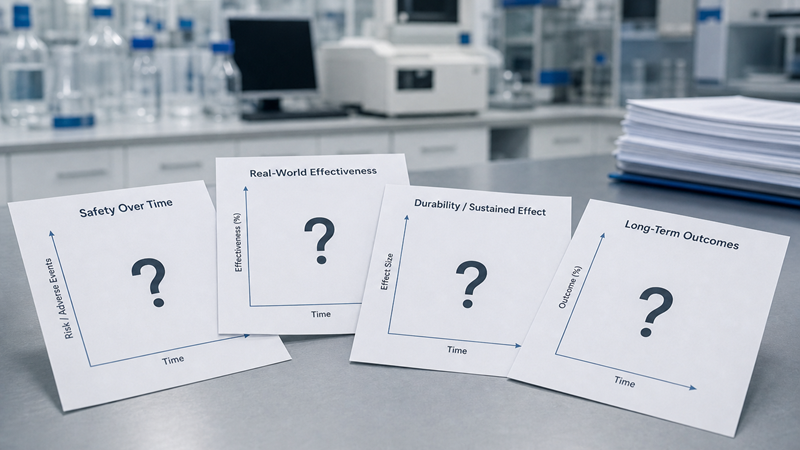
There are no published long-term comparative human studies establishing how alloclae™ performs over years, how reliably it retains volume, which patients are most likely to benefit or how its complication profile compares with conventional autologous fat transfer. Meanwhile, the product is already being used in thousands of patients, according to its manufacturer [3].
This is not a story about a product being misrepresented or patients being misled. alloclae™ is a genuine tissue-based innovation being used by qualified surgeons, and its early preclinical science is legitimate as far as it goes. The issue is the distance between how far the evidence goes and how far clinical adoption has already travelled.
That distance is where this three-part series begins.
For now, what matters is that the product solves a clear practical problem. It can provide immediate volume without requiring the patient to supply the tissue or undergo liposuction. Surgeons interviewed by Business Insider described procedure prices ranging from approximately $10,000 to as much as $100,000, depending on the volume and treatment area [4]. CNN subsequently reported that a 12.5-mL syringe could cost a patient as much as $2,250, with multiple syringes commonly required [3].
By July 2026, the manufacturer reported that more than 2,000 patients had received the product since its commercial launch in May 2025 [3]. That figure is manufacturer-reported rather than drawn from an independent registry, but it makes one point clear: this is no longer a theoretical or isolated use.
Clinical adoption has begun.

It would be easy, and wrong, to dismiss alloclae™ as a fringe treatment used only by reckless practitioners.
Board-certified plastic surgeons are offering it, and their rationale is coherent: the product provides immediate volume, eliminates donor-site surgery and can be used in an office setting under local anaesthesia. By late 2025, New York plastic surgeon Sachin Shridharani reported performing more than 50 procedures, while participating in an early clinical study examining use of the product for hip contouring [4]. Other early adopters have described similarly strong patient demand, drawn by the practical appeal of having a standardized, ready-to-use product available for patients who have little harvestable fat of their own.
The hesitation among other surgeons is not principally about the tissue’s origin. It is about where the material is being placed, how much is being used and how little clinical follow-up has yet been published.
Use as a filler in the breast generates particular concern because it is not merely a cosmetic treatment site. Breasts contain glandular, hormonally responsive tissue and are subject to lifelong cancer screening. Any procedure capable of producing palpable masses or radiographic changes must be considered in the context of future mammography, ultrasound, magnetic resonance imaging and possible biopsy.
This problem is not unique to alloclae™. Conventional autologous fat grafting can also produce fat necrosis, oil cysts and calcifications. A review of autologous fat grafting in breast reconstruction found that most postprocedural imaging findings were benign and concluded that the available clinical evidence did not show an increased risk of cancer recurrence or an inability to monitor the breast adequately [5]. The review nevertheless documented imaging changes and a mean biopsy rate of approximately 3.7% across the studies it assessed, with considerable variation between series. So, the mere appearance of an oil cyst or calcification does not establish that a procedure is unsafe, nor does every imaging change lead to an unnecessary biopsy.
The more precise question is whether treatments derived from donor tissue produce a similar, lower or higher frequency of fat necrosis, palpable abnormalities and imaging findings than autologous fat transfer, and whether those outcomes differ according to dose, injection technique or anatomical site.
No published comparative study currently answers that question.
Several surgeons interviewed in recent reporting have therefore urged caution, particularly for breast augmentation. Their argument is not that the product is necessarily harmful. It is that using large volumes in a site requiring lifelong surveillance introduces uncertainty before the imaging behaviour and longer-term clinical outcomes have been adequately characterized [6].
The absence of evidence of a unique risk is not proof that such a risk exists. It is also not evidence that the risks are equivalent.
alloclae™ is marketed by its manufacturer as a human tissue product regulated under Section 361 of the US Public Health Service Act and 21 CFR Part 1271 [2]. That pathway includes requirements related to donor eligibility, communicable-disease screening, processing and tissue practices, but it does not involve the same premarket clinical review required for a new drug, biologic or medical device [7].
The is an important distinction because “FDA-regulated” or “FDA-compliant” can sound like the FDA has evaluated and approved the product’s safety, effectiveness and durability for cosmetic use. But it has not, and they are not equivalent claims [7].
The precise regulatory classification of processed adipose products, and the dispute that has already stopped alloclae™ distribution in New York, is complicated enough to deserve its own examination. We return to it in Part 3 of this series.
The peer-reviewed alloclae™-specific literature currently centres on a 2025 paper published in Bioengineering [8].
The study characterized the product’s physical and biochemical properties, including adipose architecture, extracellular-matrix components, residual DNA and free-oil content. It also examined cellular responses in vitro and evaluated the implanted material over six months in athymic, or immune-deficient, mice [8].
It is a relevant and competently conducted preclinical study. It is not, however, a human clinical outcomes trial.
The study was financially supported by BioCreations Medical and RegenTX Labs, and all but one author were employees of RegenTX Labs, while the plastic surgeon involved was a paid consultant Tiger Aesthetics Medical, LLC, the distributor of alloclae™ [8]. Those connections do not invalidate the findings, industry involvement is common and often necessary during early product development, but they reinforce the need for independent replication and prospective clinical evidence.
As of July 2026, published alloclae™-specific studies have not established:

A widely reported patient complication illustrates precisely why those outcomes matter, while also exposing the limitations of anecdotal evidence. CNN described a woman who paid approximately $13,000 to receive 50 mL of alloclae™ in each breast. Two months later, she reported pain, discoloration and palpable lumps and was diagnosed with fat necrosis. She subsequently described oily yellow drainage and was told that surgery might be required to remove residual material [3].
The manufacturer told CNN that it had no confirmed reports of graft rejection or infection and emphasized the importance of injection technique [3]. Their reporting doesn’t contradict the patient’s experience. Fat necrosis is not the same as rejection or infection. Importantly, one reported complication cannot establish an incidence rate or demonstrate that alloclae™ carries a unique risk. It can, however, identify the kinds of outcomes that prospective studies should be designed to measure.
Without a patient registry, a defined denominator and standardized long-term follow-up, individual successes and complications remain anecdotes. They cannot tell clinicians or patients how often either occurs, and that’s worrisome.

None of this can be construed to suggest alloclae™ doesn’t work.
The product may prove to be a useful option in the right hands, for the right patient, at the right anatomical site and at an appropriate volume. The technology is scientifically plausible. The clinical need is real. The surgeons using it are not acting irrationally, and the patients choosing it are not simply being deceived by a trend.
The problem is narrower and more consequential, and it hits home for those of us in medical communications: the language of convenience has created a degree of reassurance that the published human evidence cannot yet provide. Media coverage supplied the treatment with an irresistible name: the “lunch-break boob job” [3,4].
The phrase does an enormous amount of quiet work. It makes a complex biological intervention sound routine. It also encourages an intuitive but unreliable equation: if a procedure is quick, office-based and minimally invasive, it must also be minor, and if it is minor, it must be well understood and relatively “risk-free”. It says nothing about long-term retention, tissue remodelling, imaging consequences, complication rates or what may happen years later. And those questions have yet to be answered.
Open questions are not reasons to reject innovation. They are the questions that responsible innovation should be built to answer.
Given the expense of the procedure, many patients are left asking the real question hidden beneath the marketing: Will the injected fat even stay?
In part two of this series, we investigate what a processed adipose allograft must do after injection, what determines long-term volume retention, and why concurrent GLP-1 treatment introduces an important but unanswered biological question. Check back Next Week!
This article is educational and non-promotional. It reflects publicly available reporting, manufacturer information, regulatory guidance and peer-reviewed literature as of July 2026. Clinical, regulatory and legal information concerning alloclae™ continues to evolve and should be verified against current primary sources before reliance. Individual patient accounts are illustrative and do not establish population-level incidence or causation.
References