
July 8, 2026

In Part 1 of this series, we traced the arc from Frances Kelsey’s 1960 stand against anecdotal evidence to the emergence of real-world evidence as a formally recognized category of regulatory science. The story was one of gradual legitimization, first with pharmacovigilance, then with effectiveness, followed by the 21st Century Cures Act, and ultimately resulting in Canada’s own integrated guidance framework.
But legitimization is not operationalization. Knowing that real-world evidence belongs in the regulatory conversation is different from knowing how to produce it to a standard that will survive peer review, regulatory scrutiny, and HTA evaluation simultaneously. That is where the conversation gets practical, and where the stakes for medical affairs teams get concrete.
In the eighteen months between September 2025 and March 2026, the FDA, EMA, and Health Canada collectively closed the door on the old norms. In their place is now a framework that is stricter, clearer, and far more useful for organizations prepared to meet its demands.
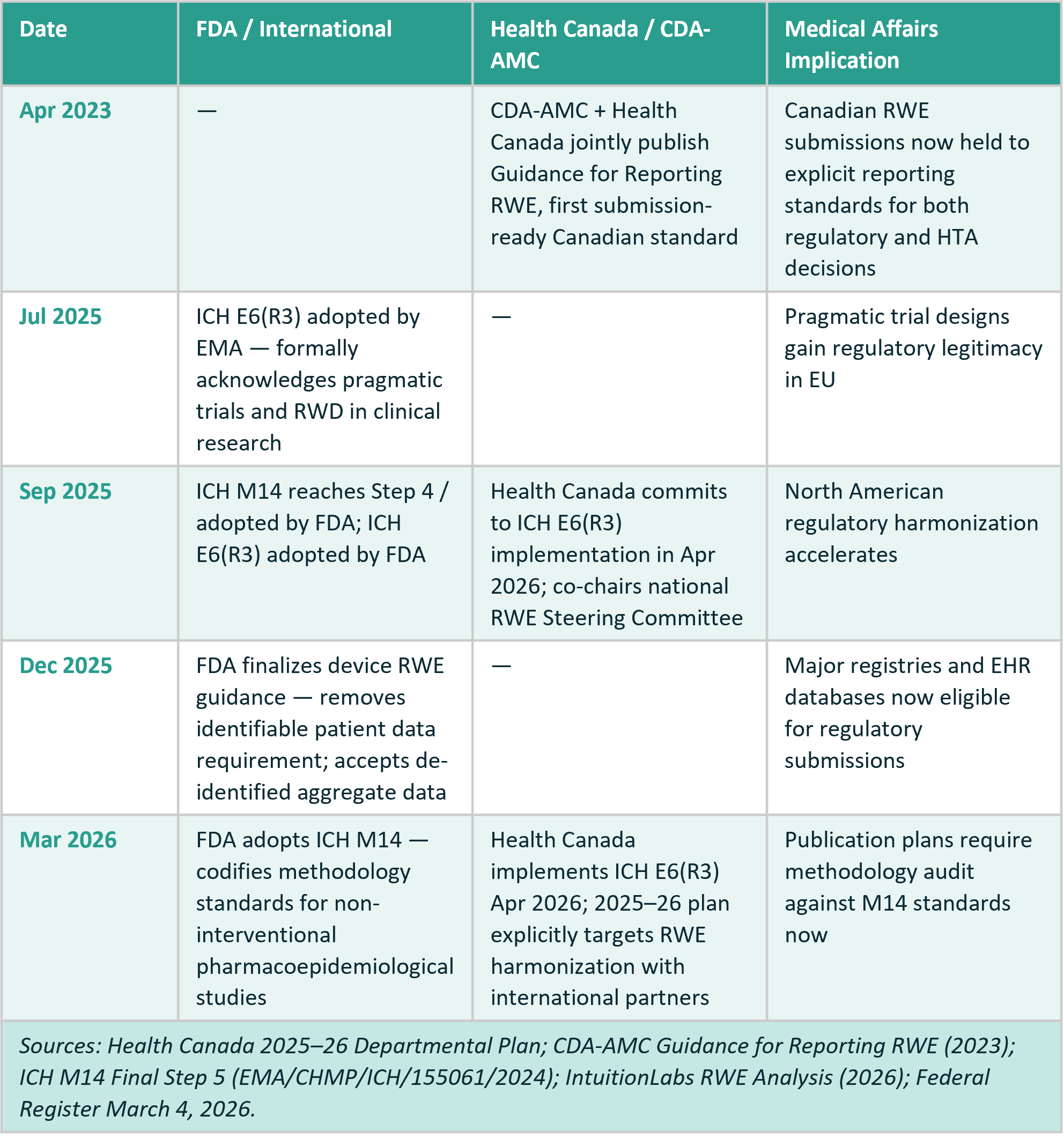
September 2025 marked the pivot point. As the FDA adopted both ICH M14 and ICH E6(R3), and Health Canada committed to E6(R3) implementation and a national RWE Steering Committee, sharply accelerating the pace of North American regulatory harmonization around RWE.
On December 15, 2025, the FDA announced it would accept real-world evidence for devices, drugs, and biologics without requiring sponsors to submit identifiable, individual patient data [1]. Two days later, it finalized updated guidance for medical devices specifically, superseding guidance that had stood since 2017 [1].
Under the previous framework, sponsors using real-world data sources faced a paradox: the most valuable datasets were large national registries, aggregated hospital system records and de-identified electronic health record databases. Unfortunately, these datasets could not provide individual-level patient data. Privacy law and data governance constraints made that impossible. The result was that the richest observational data in existence was effectively excluded from regulatory submissions.
The December 2025 guidance resolved this paradox for medical devices. De-identified, aggregate data became formally acceptable, evaluated on whether the evidence is scientifically sound and the data fit for purpose [1,2].
Then in March 2026, the FDA adopted ICH M14, a harmonized guidance developed with EMA and PMDA, establishing explicit standards for designing, analyzing, and reporting non-interventional pharmacoepidemiological studies [3,4]. At the same time, it also withdrew its 2013 best practices guidance, signaling a clean break with the old framework.

These regulatory shifts did not happen overnight. The table below maps the key regulatory milestones that span FDA, EMA, Health Canada, and CDA-AMC against their operational implications for medical affairs teams.
The phrase ‘higher methodological bar’ has appeared in nearly every commentary on ICH M14 [5,6]. But what does that mean in operational terms, and why does it matter for medical affairs teams specifically?
The table below translates the six core ICH M14 requirements into what they mean in practice, what they replace, and what they demand from publication planning teams.
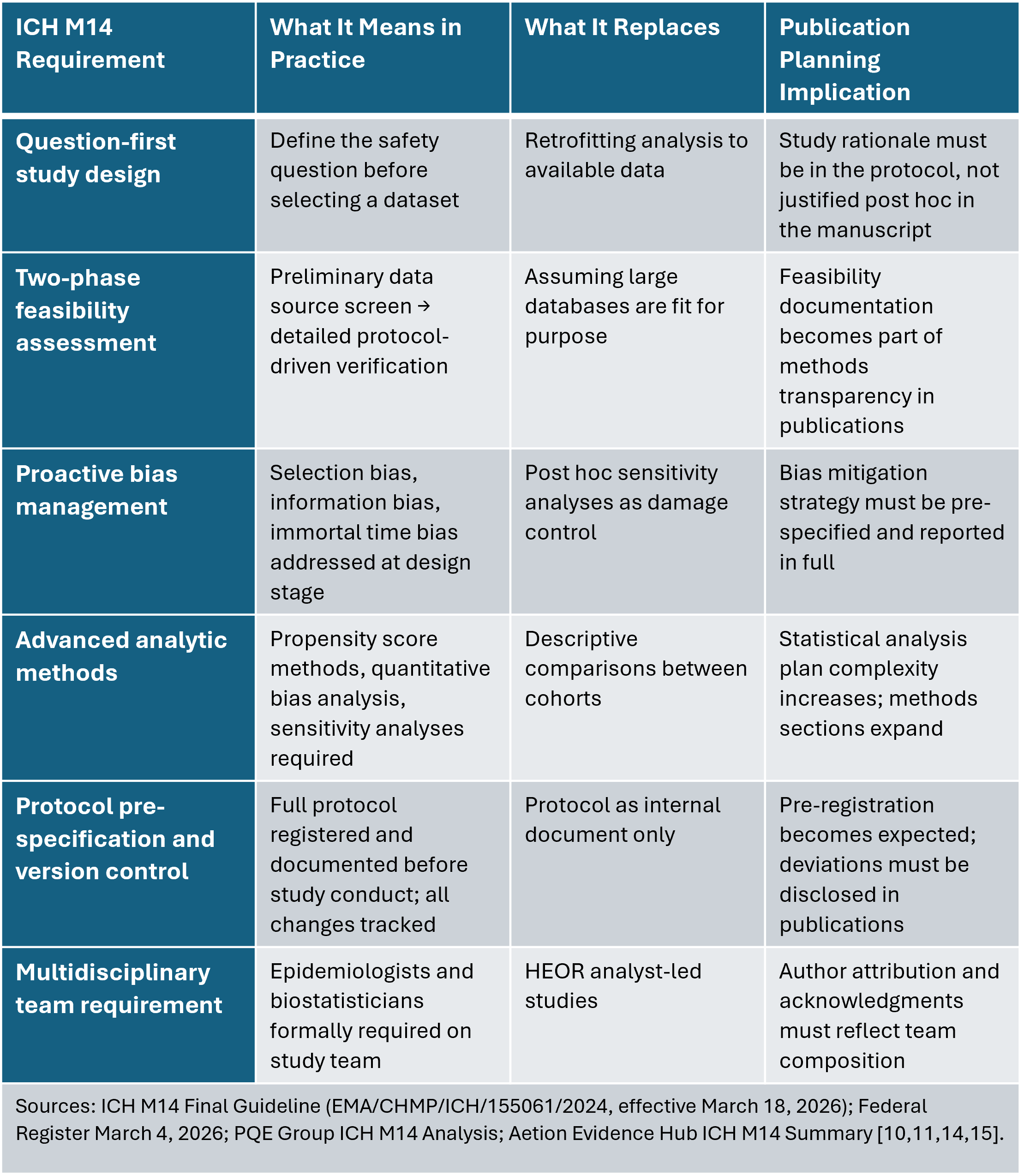
The most consequential shift, the one that will be felt most directly in publication planning, is the move from a dataset-first to a question-first model. Under previous norms, it was common practice to identify an available database and design an analysis around it. ICH M14 inverts this. The safety question is defined first. The study architecture follows. The data source is selected based on whether it is genuinely capable of answering that question, not because it happens to be available.
This has direct implications for what can be published. If the study was not designed question-first with pre-specified bias management, the manuscript’s methods section will not meet the emerging expectations of peer reviewers trained to evaluate against M14-aligned standards. The publication is the downstream output of the study design. Getting the design right is not a regulatory concern alone.
Where once the post-approval publication portfolio was built primarily around registry-confirmation studies and case series, it must now accommodate rigorous pharmacoepidemiological studies designed to regulatory-grade standards. The scientific narrative, the story your medical affairs team tells about your product across its lifecycle, can no longer treat RWE as supplementary color. It is primary evidence.
This moves demands upstream. The design of the study informs what can be claimed in the publication. The publication informs what medical affairs can communicate to payers, prescribers, and HTA bodies. The chain runs in one direction. Getting it right at the front end is not optional.

Medical affairs teams at large pharmaceuticals are already grappling with this in practice. The data infrastructure exists. The regulatory framework is now in place. The gap, increasingly, is in the strategic communication layer: the publication planning, the evidence communication, the scientific narrative architecture that translates data into clinical understanding.
Frances Kelsey was not opposed to real-world data. She was opposed to bad data dressed up as evidence. The anecdotal reports from European physicians that accompanied the thalidomide application were observational data of a kind, clinical observations, aggregated into a narrative of safety. Her insight was that the narrative was not proof. That the absence of documented harm was not evidence of safety.
The standards the FDA and Health Canada are now codifying in ICH M14 and the CDA-AMC reporting guidance reflect the same epistemological discipline that Kelsey embodied in 1960. De-identified data is acceptable, but the evidence must be scientifically sound, the data fit for purpose, and the study designed to answer the question it claims to answer. The methodological bar has risen even as the privacy barrier has fallen.
The lesson of thalidomide was never that real-world observation was worthless. It was that evidence standards matter more than evidence volume. Sixty years later, regulators on both sides of the border are working through the same problem at a different scale: not how to exclude observational data, but how to include it responsibly.
A Canadian-born pharmacologist helped build the modern regulatory framework. Her country is now helping build its next chapter.
The FDA has indicated it intends to update parallel RWE guidance for drugs and biologics following the device guidance. The ICH M14 adoption signals international harmonization of non-interventional study standards across FDA, EMA, and PMDA. Health Canada’s ICH E6(R3) implementation in April 2026 brought Canadian clinical research standards into full alignment. The EMA’s DARWIN EU network continues to expand real-world data infrastructures across the European Union.
We are at the beginning of a decade in which real-world evidence will become, for many therapeutic areas, the dominant form of post-approval evidence. The organizations that understand that shift, that can generate, design, and strategically communicate real-world evidence to its full potential, will define the next era of medical affairs.

If your organization is rethinking its RWE strategy in light of this evolving guidance, get in touch and let’s talk about practical ways Craft Science Inc. can support your medical affairs and evidence teams!
References
[1] Federal Register :: Use of Real-World Evidence To Support Regulatory Decision-Making for Medical Devices; Guidance for Industry and Food and Drug Administration Staff; Availability, (n.d.). https://www.federalregister.gov/documents/2025/12/18/2025-23252/use-of-real-world-evidence-to-support-regulatory-decision-making-for-medical-devices-guidance-for
[2] FDA finalizes real-world evidence guidance for device sponsors, may consider more RWE in product reviews,(n.d.). https://www.hlc.com/en/publications/fda-finalizes-realworld-evidence-guidance-for-device-sponsors
[3] M14 General Principles on Planning, Designing, Analyzing, and Reporting of Non-interventional Studies That Utilize Real-World Data for Safety Assessment of Medicines | FDA, (n.d.). https://www.fda.gov/regulatory-information/search-fda-guidance-documents/m14-general-principles-planning-designing-analyzing-and-reporting-non-interventional-studies-utilize
[4] ICH M14 guideline on general principles on plan, design and analysis of pharmacoepidemiological studies that utilize real-world data for safety assessment of medicines – Scientific guideline | European Medicines Agency (EMA), (n.d.). https://www.ema.europa.eu/en/ich-m14-guideline-general-principles-plan-design-analysis-pharmacoepidemiological-studies-utilize-real-world-data-safety-assessment-medicines-scientific-guideline
[5] ICH M14: A Harmonized Approach to Non Interventional Studies, (n.d.). https://blog.pqegroup.com/regulatory-affairs/a-harmonized-approach-to-non-interventional-studies
[6] From Real-World Data to Regulatory Action: Understanding FDA’s ICH M14 Guidance – FDA Map, (n.d.). https://www.fdamap.com/blog/from-real-world-data-to-regulatory-action-understanding-fdas-ich-m14-guidance/