
May 12, 2026
On April 2, 2026, the U.S. Food and Drug Administration issued a warning letter to a Michigan-based manufacturer of drug products called Purolea Cosmetics Lab. At first glance, it looked routine: cGMP violations, missing process validation, inadequate quality controls. But buried in the letter was something unprecedented: a dedicated section titled “Inappropriate Use of Artificial Intelligence in Pharmaceutical Manufacturing.” For the first time, the FDA explicitly cited AI misuse as a named compliance deficiency in a cGMP enforcement action.1
So what happened at Purolea? The company used AI agents to generate drug product specifications, standard operating procedures, and master production records, core compliance documents, and then deployed them without meaningful human review. When FDA investigators identified that products have been distributed without process validation, a foundational cGMP requirement, the company’s response was startling: they said they didn’t know it was required because their AI tool hadn’t flagged it.2,3
Read that again. A drug manufacturer outsourced part of its regulatory judgement to a language model. When the model missed a critical requirement, the company inherited the failure.
The FDA’s position was unambiguous: AI does not excuse the failure to implement fundamental controls. If a firm uses AI to support cGMP activities, every output must be reviewed and approved by an authorized human representative of the quality unit.1 This is not a new regulatory standard, it is the application of existing regulatory requirements to a new technology.
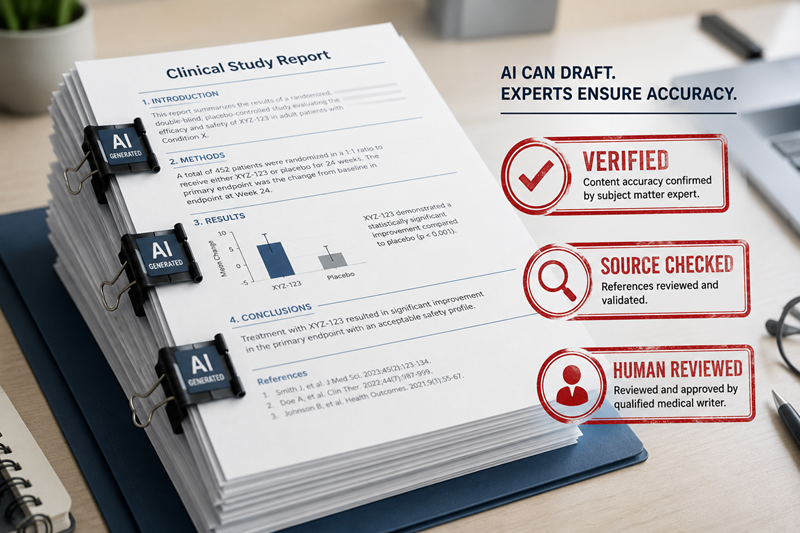
It would be convenient to treat the Purolea letter as a cautionary tale about a small company that cut corners. But the underlying failure, trusting AI-generated documents without expert verification, is not confined to manufacturing. It is happening across the pharmaceutical content lifecycle right now, including in medical writing, regulatory submissions, and medical affairs.
The parallels are uncomfortable. AI tools can draft a clinical study report, generate a literature review, or produce publication-ready references in a fraction of the time it takes a human medical writer. The output reads fluently. The formatting is professional. The citations look real. But that is precisely the problem, looking real and being real are not the same thing. Published analyses have shown that large language models fabricate scientific references at significant rates.4,5 One independent analysis found that 55% of citations generated by GPT-3.5 were entirely fabricated. GPT-4 performed better, but still produced fabricated references in 18% of cases. With both models even non fabricated citations included substantive citation errors.6 These are not formatting errors. They are invented author names, fictitious journal articles, and non-existent DOIs, all presented with the same confidence as legitimate evidence.
And the issue extends beyond references. In April 2026, Nature reported on a remarkable experiment: a researcher at the University of Gothenburg, Sweden, invented a fictitious eye disease called “bixonimania,” published fake preprints online, and then watched as major AI systems, including OpenAI’s ChatGPT, Google’s Gemini, Microsoft’s Copilot began confidently describing the condition as real, complete with clinical explanations, relevance and referral recommendations. The contamination didn’t stop at chatbots. A peer-reviewed paper in Cureus (a journal published by Springer Nature) cited the fake research as legitimate before it was retracted.7
The lesson for medical affairs is clear: AI systems do not evaluate evidence. They generate plausible text. In regulated environments, that distinction matters.
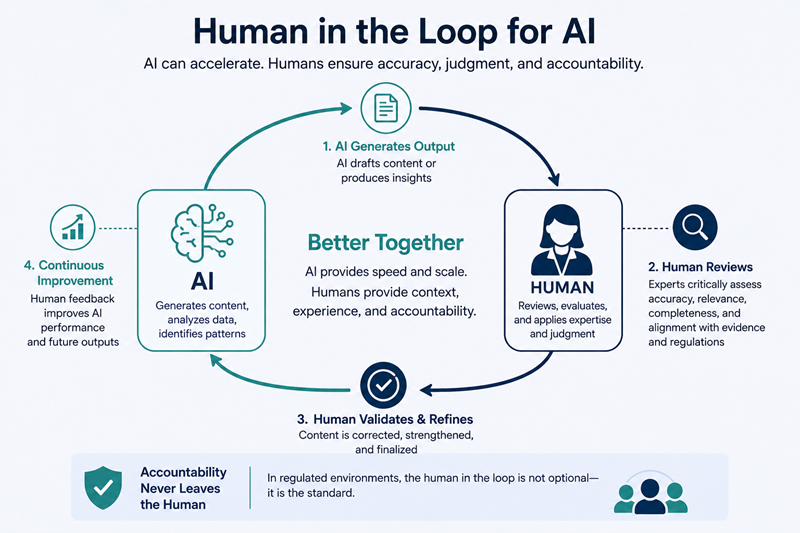
None of this is an argument against using AI in medical writing or medical communications. Used appropriately, AI tools can accelerate first drafts, support literature synthesis, identify patterns in large datasets, and reduce the burden on repetitive formatting tasks. In the right hands, it can make medical writers more efficient without compromising quality.
The critical phrase is in the right hands. AI is only as reliable as the person evaluating its output. An experienced medical writer will flag fabricated references, question a mechanism of action that doesn’t align biologically, or recognize when a cited trial population doesn’t support the claim being made. An AI tool will not. It will present all of these with equal confidence.
This is exactly the distinction the FDA drew in the Purolea letter. The agency does not prohibit the use of AI in cGMP activities. It prohibits the absence of qualified human oversight. The same principle applies, or should apply, across every regulated content workflow in pharma, from the clinical study reports to publication plans to slide decks.
The broader regulatory landscape is reinforcing this expectation. In January 2026, the International Committee of Medical Journal Editors updated its recommendations to further clarify expectations around the disclosure of AI use in manuscript preparation, including drafting, editing, literature summarization, and figure generation.8 Similarly, the International Society for Medical Publication Professionals first issued its position statement on artificial intelligence in 2023, followed by enhanced practical guidance in 2025 emphasizing that organizational policy, transparent disclosure, and qualified human oversight are essential for responsible AI integration in medical communications.9,10 Even Good Publication Practice, published before the current wave of generative AI, is grounded in the same principle: publication professionals remain accountable for scientific accuracy, interpretive integrity, and transparency, regardless of the drafting tool used.11
For medical affairs teams, the Purolea warning letter is a signal to ask harder questions, not just about their own AI adoption strategies, but also about the agencies, vendors, and consultancies producing their content.
When your medical communications partner delivers a manuscript, regulatory document, or clinical guidelines, are the references verified against primary sources? Has the scientific content been evaluated by someone with the expertise to recognize when a claim stretches beyond the evidence? Or was it generated by a tool that writes fluently but doesn’t actually understand it’s talking about?
The organizations that will navigate this well are the ones that treat AI for what it is: a powerful accelerator that still requires a scientist judgment at the controls. The ones that will struggle are the ones that confuse speed with sufficiency, the same mistake Purolea made, just in a different part of the value chain.
The FDA has now shown us what enforcement looks like when the human is removed from the loop. The question is whether the rest of the industry will learn the lesson before it reaches them.
References