
May 5, 2026
Here’s a pattern I’ve seen repeatedly.
A medical affairs team builds a publication plan. Timelines align to a congress deadline. Authors are confirmed. A solid first draft is delivered on time.
Then the manuscript enters medical-legal-regulatory review, and disappears.
Weeks later, it resurfaces covered in tracked changes that contradict each other. Medical pushes for bolder claims. Legal wants hedged language. Regulatory flags references that don’t align with labeling. The author’s voice has been edited out entirely. Revisions begin. Another round follows. Then another. The congress abstract deadline passes.
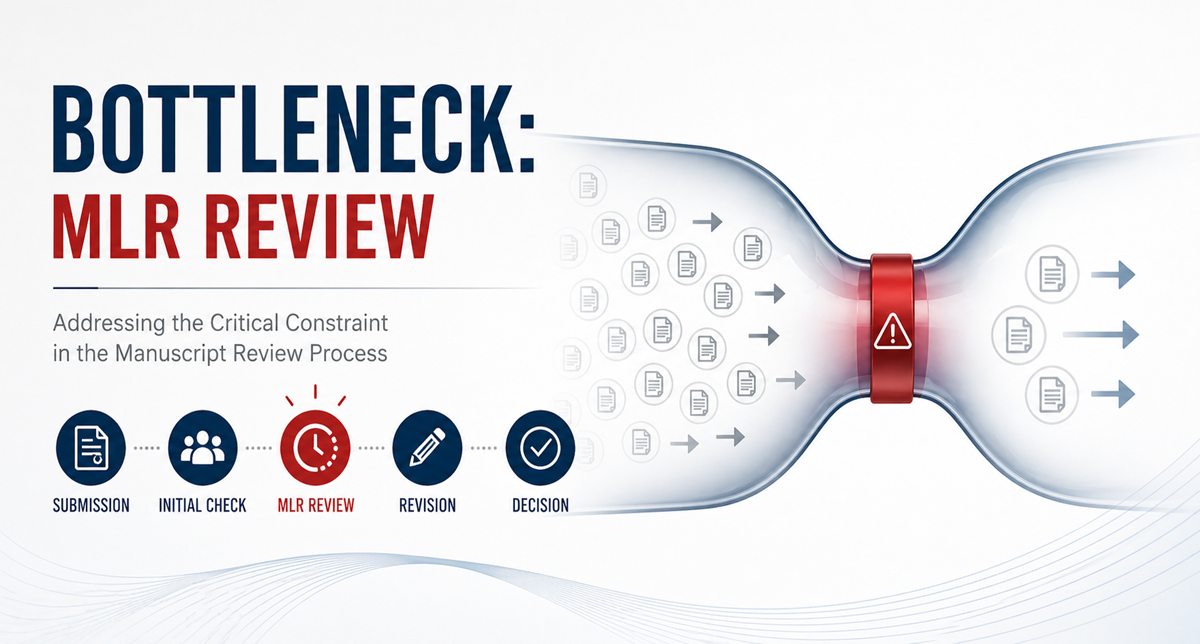
Everyone reaches the same conclusion: “MLR is the bottleneck.”
It’s not. It’s the visible failure point.
The document was never set up to pass.
The Problem Starts Before the First Draft
Precise industry benchmarks on MLR cycle times are hard to come by, most data lives inside vendor white papers and platform analytics, not peer-reviewed research. Indegene has reported that the end-to-end process from draft to distribution typically takes up to 40 days; Caidera estimates 50 to 60 days at mid- and large-sized companies under standard workflows. Veeva’s own content benchmark data suggests the picture is more nuanced: the review itself may be consistent, but pre-review processes can add anywhere from 5 to 150 days per asset. What everyone agrees on is the root cause: the most significant delays stem not from the review itself, but from incomplete submissions and fragmented feedback upstream.1–3
Content volume has increased steadily year over year while reviewer headcounts have remained stagnant or declined, creating a structural mismatch between what MLR teams are asked to review and the resources available to do.1 AI-powered compliance tools are emerging to accelerate reference checks and compliance workflows. But none of that addresses the core issue.
Most manuscripts enter MLR misaligned at the claim level, the evidence level, and the strategic level. Review then becomes corrective rather than confirmatory. The failure happens in the space between the publication plan and the first draft, the outline stage, the claim-level planning, the conversations about what a manuscript is trying to do strategically, not just what it needs to say scientifically. That gap is where publication timelines go to die.

Across therapeutic areas, from rare disease to metabolic disorders to neuroscience, the same three root causes emerge.
This is the single most common source of conflict. The author wants to say the data “demonstrate” efficacy. Legal wants “suggest.” Regulatory pushes for something in between, like “indicate” if the claims stay within approved labeling, but nobody clarified that boundary before the draft was written.
The result is not a simple edit, but a tug-of-war fought in tracked changes, one assertion at a time, across every section of the document. A 30-minute alignment meeting before the outline is drafted can eliminate one to two full review cycles.
Medical writers typically draft for the target journal audience: physicians, researchers, the scientific community. The science is accurate, the language precise. But MLR reviewers read through a completely different lens. They are assessing whether each claim is supportable, on-label, and traceable to a defined evidence source.
When a manuscript is drafted without anticipating those expectations, the first MLR review cycle becomes a line-by-line interrogation that could have been a straightforward sign-off. This is the core upstream failure: the regulatory and legal lens gets applied for the first time at review, when it should have shaped the document from the outline stage. The claims, the assertion level, the reference architecture, all of it can be aligned before a single paragraph is written, but it often isn’t.
Writers are often briefed on topic, length, and deadline. The underlying objective, what the publication is meant to do in the broader evidence plan, is rarely articulated clearly.
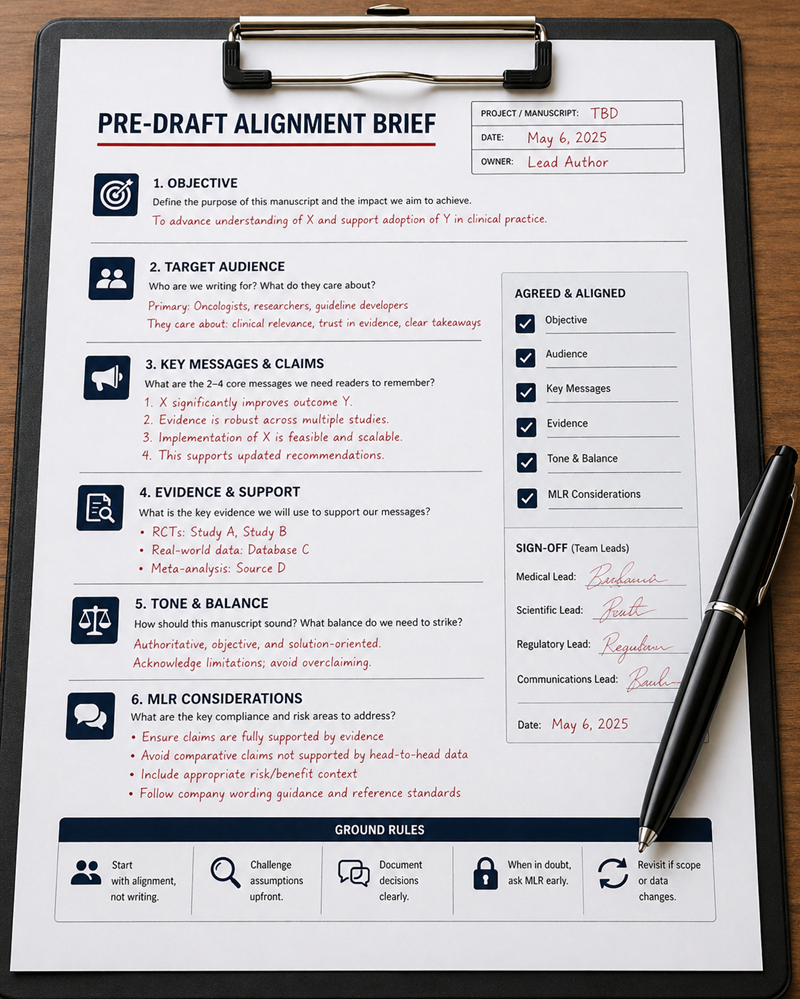
At Craft Science, we address this with a Pre-Draft Alignment Brief completed before the outline stage.
It is deliberately simple. It forces five decisions to be made explicitly:
This typically takes 30 minutes to align. In practice, it removes one to two full review cycles.
More importantly, it changes how the manuscript is built. The draft arrives structured to withstand scrutiny, with claims, evidence, and intent already aligned.
MLR becomes a confirmation step, not a reconstruction exercise.
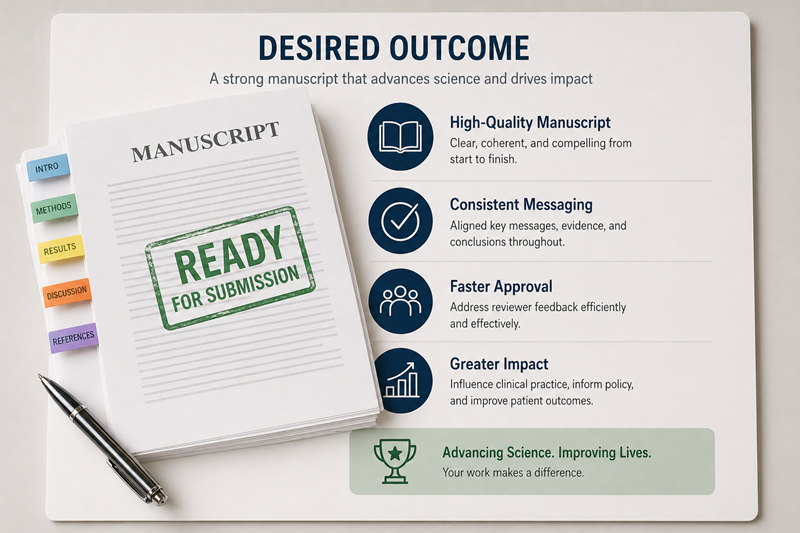
The impact is not just operational. Missed congress deadlines mean data is absent from key clinical conversations. Delayed publications leave MSLs without current materials. Repeated review cycles strain internal teams and external partners.
In an environment where HCP attention is limited and selective, showing up late often means not showing up at all.
Efficient publication is not about speed alone. It is about being present in the moments that shape clinical thinking.
There is a related factor that becomes visible in MLR. Manuscripts written with strong scientific integration tend to require fewer corrections. Claims are inherently defensible. Evidence is appropriately matched. Framing aligns more naturally across medical, legal, and regulatory perspectives.
This is not about writing style. It is about how deeply the science, the evidence landscape, and the strategic objective are understood at the time of drafting. The alignment brief improves any process. But its impact is magnified when the person building the manuscript can anticipate where scrutiny will arise and structure the content accordingly.
If your recent publications have required multiple MLR cycles, it is worth looking upstream.
First, review your last two MLR review cycles. Pull the tracked changes from the most recent publication that required three or more review rounds. Categorize the comments: how many were about assertion level? How many were about references not mapping to claims? How many were about strategic framing? If the majority fall into those three buckets, you have an upstream problem, not a review problem.
Second, implement a pre-draft alignment step. Ensure the writer has visibility into both the scientific and strategic context. Define claim boundaries early.
These are small interventions. Their impact is disproportionate.
The MLR bottleneck is real. But it is rarely solved at the point where it becomes visible. The fix isn’t faster review— it’s smarter preparation, and writers who understand the science well enough to make the review easy.
References & Further Reading