
October 28, 2026
Quantum computing was not something I expected to spend much time thinking about after attending a life sciences conference. Then I heard IonQ speak at the recent NGBi Summit.
The numbers attached to quantum computing in life sciences are difficult to ignore. McKinsey has estimated that quantum computing could create between $200 billion and $500 billion in value for the life sciences industry by 2035, with drug discovery among the applications expected to benefit [1]. Capgemini reports that approximately one in five organizations across energy, chemicals and life sciences are already implementing quantum technologies through experiments, pilots or early applications [2].
At the same time, a 2025 Pistoia Alliance survey found that expected use of quantum computing in life sciences laboratories over the following two years had actually slipped from 20% to 18%, as organizations concentrated on technologies with more immediate utility like AI [3].
Are we standing at the beginning of a computing revolution that could reshape drug discovery, or looking at another emerging technology surrounded by projections that outpace the evidence? The answer is most likely a combination of both. And that makes quantum computing worth understanding now.
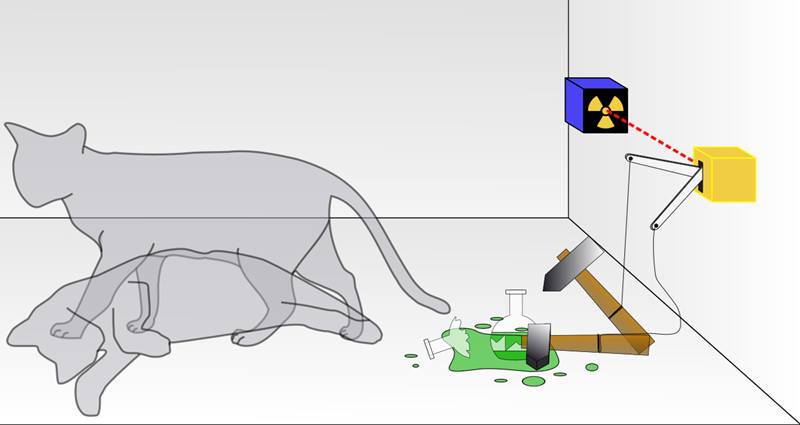
Most scientists are familiar with the “Schrödinger’s Cat” thought experiment. A cat is placed in a theoretical box with a quantum event that determines whether it lives or dies. Until the box is opened, quantum mechanics describes the system as a superposition of possibilities, famously simplified as the cat being both alive and dead.
Schrödinger devised the thought experiment in 1935 partly to show how strange quantum mechanics becomes when its rules are stretched from single particles to the everyday world. Few people remember that he meant it as a criticism of the theory. In reality, a cat is never in a superposition of alive and dead. A cat is made of vast numbers of particles that constantly interact with their surroundings, and those interactions rapidly destroy quantum behaviour (decoherence). Superposition is real, but it is observed in isolated, microscopic systems such as atoms, ions and engineered circuits.
By the 1920s, physicists had developed quantum mechanics into an extraordinarily successful framework for describing atoms, electrons and chemical bonds. The equations worked, but solving them was becoming an increasingly difficult problem. A small quantum system may be manageable, but as interacting particles are added, the number of states that must be considered grows exponentially. Conventional computers helped, but they did not eliminate the underlying scaling problem.
Eventually, physicists began to wonder whether the difficulty lay not only in the problem they were trying to solve, but in the kind of computer they were using to solve it. What if the computer behaved like the system it was modelling?
In 1980, physicist Paul Benioff formally showed that a theoretical computer could itself be described using quantum mechanics [4]. Two years later, Richard Feynman pushed the idea much further. In his influential 1982 paper Simulating Physics with Computers, Feynman considered what happens when a classical computer attempts to simulate a quantum system [5]. He positied that if nature is quantum, perhaps the most natural way to simulate nature is with a machine that is quantum too.
That machine is a quantum computer. A conventional computer stores information as bits, and each bit is either 0 or 1. At the scale of atoms and subatomic particles, nature works differently. A particle can exist in a blend of many possible states at once, and when we measure it, we can only predict the odds of finding it in a particular state. A quantum computer uses this behaviour to build “qubits”, the quantum counterpart of bits. Particles can also become “entangled”, which means their fates are linked, even when they are far apart. Each extra qubit doubles the number of possibilities the machine can work with, so the number of possible states grows exponentially. That is the same kind of growth that overwhelmed conventional computers, now works in the machine’s favour.
In 1985, David Deutsch conceptualized a universal quantum computer: a programmable machine that could, in principle, perform many different kinds of computation using quantum mechanics [6]. It was a landmark idea, but it was also a solution in search of a problem. No one had yet shown a task for which such a machine would actually be worth building. That changed in the 1990s, when researchers began developing algorithms that revealed what a quantum computer might be good for.
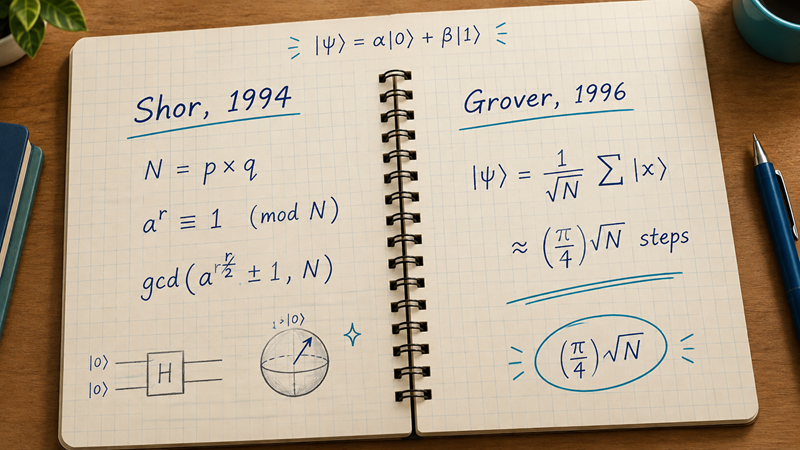
In 1994, Peter Shor demonstrated that a quantum computer could theoretically factor very large numbers far more efficiently than any known classical approach [7]. The result had major implications for cryptography, because many encryption systems rely on the difficulty of this very task. Two years later, Lov Grover developed a quantum algorithm that could accelerate searches through large unstructured collections of data [8].
The details of factoring and searching matter less here than the principle they established. Quantum computers would not necessarily outperform classical computers at everything, but the algorithms suggested they would be ideally suited to solve certain classes of problems. That was enough to turn quantum computing from an intriguing theoretical possibility into an engineering challenge.
By the late 1990s, researchers were testing whether quantum algorithms worked in the real world. In 1998, Chuang and colleagues ran a tiny version of Grover’s search algorithm on a quantum system built from molecules, using nuclear magnetic resonance [9]. In 2001, researchers at IBM and Stanford used a seven-qubit system to run Shor’s algorithm and factor the number 15, which is only a small number but a real proof of principle [10]. These experiments were small and could not outperform an ordinary computer. They mattered because they showed that algorithms that had existed only as mathematics could be run on real quantum hardware and give the right answer.
The central question shifted from “Is quantum computing possible?” to “Can we build quantum computers large and reliable enough to do something useful?” More than two decades later, that remains one of the defining questions in the field.

This is where the story of quantum computing begins to intersect directly with life sciences.
Feynman understood that nature, at its most fundamental level, plays by quantum rules. Molecules are quantum systems. Their behaviour ultimately depends on electrons, nuclei, bonds and interactions governed by quantum mechanics. As molecules become larger, accurately calculating their electronic structure becomes increasingly difficult.
Classical computational chemistry handles this challenge remarkably well by using approximations, including density functional theory and other mathematical methods. But every approximation trades accuracy for feasibility, and for some problems that trade-off limits what can be reliably predicted. A quantum computer offered a different route: model a quantum system using a quantum machine.
In 2005, Alán Aspuru-Guzik and colleagues published an influential Science paper demonstrating how quantum algorithms could, in principle, calculate molecular energies [11]. The systems were small and the quantum computation itself was simulated on a classical computer. Even so, but it proved that chemistry could be mapped onto quantum computation.
That mattered because quantum computing began with the idea that quantum machines might be best suited to simulating quantum physics, and chemistry is quantum physics. Much of drug discovery ultimately depends on chemistry. Questions involving molecular energies, electronic structures, reaction mechanisms and eventually molecular interactions suddenly had a plausible connection to quantum computation.
Life sciences had exactly the kind of problem quantum computing could potentially address.
It turns out that imagining a quantum computer big enough to solve complex problems is much easier than building one. The very properties that make qubits powerful, (superposition and entanglement), also make them delicate. Tiny disturbances from the environment, such as heat, vibration or electromagnetic noise, can make a qubit lose its quantum information (decoherence) causing errors. Qubit operations are also imperfect, and in a calculation with many steps, those small errors accumulate. Run a thousand operations in a row without error correction and the result would be nonsense.
Over the last few decades, researchers have developed several approaches to quantum hardware, including superconducting circuits, trapped ions, photons, neutral atoms and quantum annealers. The machines became larger, control improved, error rates fell, but qubit fragility has remained a major hurdle. No system to date has shown sustained, at-scale fault-tolerant operation, but new systems are on the horizon.
In 2018, physicist John Preskill captured this in-between moment by describing the emerging generation of machines as belonging to the Noisy Intermediate-Scale Quantum, or NISQ, era [12]. The name is unusually useful because each word is accurate. These machines are no longer theoretical: they can perform real computations and scientifically interesting experiments. But they are still noisy, relatively small and unable to reliably execute many of the deep, complex calculations imagined in the original algorithms.
This is where the field sits today.
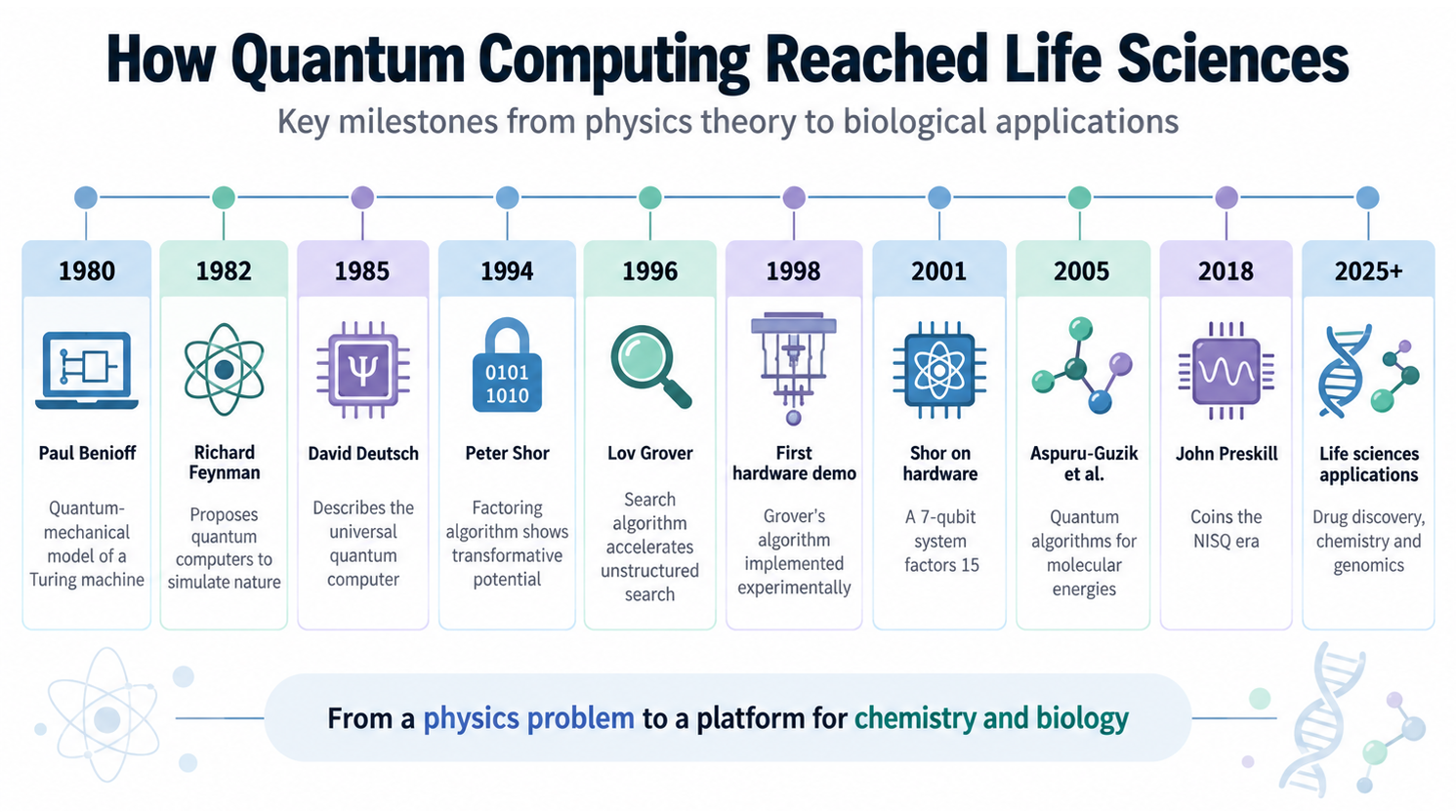
Quantum computing was not developed for drug-discovery. It emerged because physicists encountered problems that classical computers struggled to represent efficiently, and life sciences has plenty of those: molecular electronic structure, reaction energetics, protein conformational landscapes, optimization problems, genomic search spaces, and chemical spaces containing numbers of possible molecules far beyond anything we could ever synthesize and test experimentally.
The attraction is real, but so is the distance between theoretical promise and practical use. Proving that quantum mechanics confer a computational advantage is one milestone. Writing an algorithm that exploits it is another. Building hardware that can run it at biologically relevant scales is a third. Demonstrating that the result actually improves a real pharmaceutical or biological decision is a fourth. Those stages are often collapsed into the single phrase “quantum computing,” which can make the field sound considerably more mature than it is.
The question is no longer whether quantum computers can be built and solve problems – some have outperformed existing supercomputers on carefully chosen benchmark tasks. The open question is whether today’s quantum computers can solve real biological problems better than the classical methods we already have.
In Part 2, we look at what researchers have actually tried, from KRAS inhibitor design and protein folding to genomics and antimalarial drug discovery, and where quantum computing has succeeded, failed or simply run into the limits of the hardware.
References