
November 17, 2026
In Part 1 of this series, we traced how quantum computing emerged from a physics problem where classical machines struggled to simulate quantum systems. Because molecules are quantum systems, it found a new home in biochemistry. Suddenly, the quantum connection to life sciences that was first posited by Feynman in 1982 was no longer theoretical. But theory and practice don’t always align. In this article we examine what happened when researchers pointed today’s quantum hardware at real biological problems.
Why Molecules Make Quantum Computing Relevant to Us
A conventional computer represents information using bits that exist as either 0 or 1. Quantum computers use quantum bits, or qubits. Through a property called superposition, a qubit can represent combinations of states until it is measured. Qubits can also become entangled, meaning their states are correlated in ways that have no direct classical equivalent [1].
For life sciences, predicting how electrons are distributed within molecules, how chemical bonds behave, how molecular structures change or how reactions proceed are quantum-mechanical problems. As molecular systems scale, the number of possible electronic configurations expand exponentially, rendering exact calculations computationally prohibitive for classical computers.
To solve these problems today, we rely on highly useful approximations, like density functional theory, molecular dynamics, machine learning, and increasingly sophisticated AI. But approximation comes with trade-offs. Quantum computing offers an architecture that could tackle these biological problems directly, at least in theory.
We Already Have Quantum Biology Experiments, But Not the Kind the Headlines Imply
Perhaps the most compelling evidence so far is in drug design. In a 2025 Nature Biotechnology paper, researchers combined quantum and classical computing to generate candidate inhibitors of the Kirsten rat sarcoma virus (KRAS) gene. KRAS is the most frequently mutated gene in non-small cell lung cancer (NSCLC), making it one of the most important and yet historically difficult oncology targets [2].
This was not simply an in-silico exercise. The researchers used a 16-qubit quantum circuit (a type of generative model that learns molecular patterns) alongside a conventional long short-term memory model (that also learns and remembers over time) and other classical computational tools to generate candidate molecules. Fifteen molecules were subsequently synthesized and experimentally tested in cell-based experiments, with two showing real promise in KRAS inhibition [2]. This marks a milestone: it shows that quantum computing can move beyond algorithms on a screen and help design biologically active molecules that can be produced in a wet lab. However, the cell experiments assessed only molecular interactions and general effects on cell viability, they did not establish that the compound could be an effective oncological treatment [2].
Another limitation is that the study did not establish quantum advantage, and the authors explicitly acknowledged this [1]. The workflow remained heavily hybrid: quantum generation sat inside a pipeline containing classical machine learning, molecular docking, computational filtering and experimental selection.
Quantum contributed to a successful drug-discovery workflow. That is not the same as demonstrating that quantum computing was required for it to be successful.
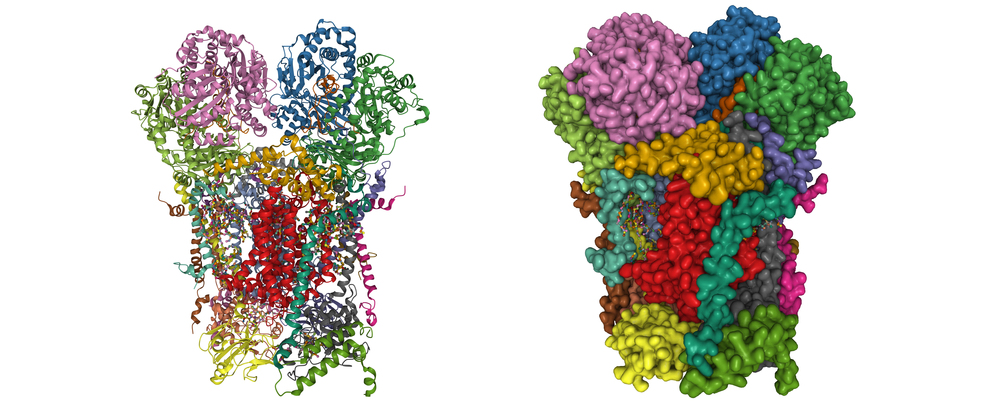 Folded protein representation of human respiratory complex III (depositphotos.com)
In Protein Folding the Classical Bar is Already High
Protein folding and protein design are often presented as ideal quantum applications due to their massive combinatorial search spaces. But the field already has a classical breakthrough to contend with: AlphaFold, which predicts protein structures with near-experimental accuracy using deep learning on conventional hardware.
In 2022, Irbäck and colleagues used a D-Wave quantum annealer, a type of quantum computer built to find the lowest-energy solution to a problem, to fold simplified model proteins [3]. It found low-energy structures, but the model placed each amino acid on a grid and sorted it as either hydrophobic or polar. The result was an optimization exercise inspired by protein folding, but far from anything approaching the atomic complexity of a real protein in a biological environment.
A study in 2026 Scientific Reports pitted quantum annealers against classical methods in a direct test of protein folding capabilities, and the quantum systems fell short [4]. Despite working on simplified models, some quantum versions produced structures that were physically impossible. Quantum annealers also hit hardware capacity limits, so the benchmarks stopped at peptides of just ten amino acids. This limit is far below what is needed for typical therapeutic targets – for example, GLP-1 agonists are 31-39 amino acids long. The authors concluded that current quantum annealers can’t handle folding beyond proof-of-concept [4].
These studies illustrate that quantum algorithms can solve carefully constrained versions of biological problems. Real biology, however, remains beyond their reach, and the classical bar keeps rising.
 Representation of Sanger DNA Sequencing results (depositphotos.com)
The Pattern Repeats Across the Literature
Applying quantum workflows to protein design tells a similarly disappointing story.
In 2023, Khatami and colleagues developed a gate-based quantum protein design algorithm that leveraged Grover’s search (a method that can check multiple possibilities simultaneously, offering a theoretical speed advantage) [5]. The method produced the theoretically expected quadratic speed-up over exhaustive classical search in simulated quantum systems. But those larger calculations were performed on quantum simulators with circuits requiring up to 234 qubits, running on classical computers. They would need a much more compact algorithm to run on actual quantum hardware [5].
Genomics has proved just as difficult. Sequencers read DNA in millions of short fragments, and each one has to be matched to its correct position in a reference genome. This step, called alignment, is a major computational bottleneck. In 2023, Varsamis and colleagues developed a gate-based quantum algorithm for alignment and tested it on IBM quantum processors and simulators [6]. The work demonstrated that sequence-alignment problems can be framed as a problem for quantum computing. But showing something can be done is not the same as showing it works better. The study was a proof of concept, not evidence that quantum hardware can analyze real genomes faster, cheaper or more accurately than today’s highly optimized classical tools.
And sometimes quantum simply does not win. A 2024 study tested whether quantum machine-learning approaches could identify compounds with antimalarial activity [7]. The researchers first had to compress the information describing each molecule, such as its size, charge and structural features, into a much smaller set of numbers. They then compared variational quantum classifiers (a type of AI model adapted to run on quantum hardware) against established machine-learning approaches. Some quantum models performed reasonably on the compounds they were trained on. On new compounds they hadn’t seen before, however, they were only right about half the time, no better than a coin flip. A conventional machine-learning method, the support vector machine, out-performed them [7].

What All of This Actually Tells Us
Every study examined in this post tells the same story from a slightly different angle. Researchers can formulate biological problems for quantum hardware. The algorithms can solve carefully constrained versions of those problems. In one case, molecules generated through a quantum-containing workflow reached a wet lab and showed biological activity. That is real progress and it should be taken seriously.
But in every case that has failed, and even those that were successful, the hardware continues to be the limiting factor. The protein-folding models work on peptides of ten amino acids, not therapeutic targets. The protein-design algorithms run on classical simulators because the quantum machines are not large enough. The antimalarial classification lost to a conventional support-vector machine because the data had to be compressed so aggressively to fit the hardware that the biological signal was lost. The KRAS study succeeded, but its authors were careful to say the quantum component did not yet provide an advantage that classical methods could not match.
The algorithms are ready. The hardware is not. And that gap between what quantum computation can theoretically offer and what it can physically deliver today is the single most important thing to understand about this field.
In our final article in this series, we look at what it will take to close that gap, including the engineering problem of fault tolerance, why chemistry will likely benefit before biology, and what pharmaceutical R&D teams can do right now to make sure they are ready when the hardware catches up.
References